
Seiko 2010 SKX013 Diver, 7S26
“More than nostalgia.”
The Seiko SKX013 and its siblings hold a special place within the watch community.
Produced from 1996 to 2019, the SKX continues to generate discussion despite countless newer dive watches offering better specifications, better finishing, and even better value. Yet it remains one of the hobby’s most enduring references.
Specifications
- Model: 2010 SKX013
- Retail Price: $450 USD in 2018
- Reference: SKX013
- Movement: Automatic Caliber 7S26, non-hacking, 17 jewels, 21,600 vph, non-magnetic, +-20 seconds
- Power Reserve: 40 hours
- Dial: Matte dark grey, LumiBrite, date English & Kanji
- Bezel: Unidirectional steel
- Case: 37mm, 43mm lug-to-lug, screw down crown, decorated case back
- Thickness: 13mm or 12mm (w/ mod)
- Water Resistance: 200m ISO Certified
- Crystal: Scratch Resistant Hardlex
- Lug Width: 20mm
- Bracelet: Jubilee (solid links w/ clasp) signed clasp
- Strap: Rubber Strap
- Box and Papers: Yes
- Favourite Paired Strap: Grey Nato
- Produced: 1996 to 2019
Acquired: Jan. 11, 2019, from the original owner who purchased the watch Aug. 2018.
Service History: None.
.
Why I Got It
Early in my collecting journey, after buying my first automatic watch for the office, I wanted something I could wear without a second thought.
The answer, according to nearly every watch forum I visited, was the Seiko SKX.
It was affordable (around $150 USD), had rugged specifications, and a striking design. More importantly, at 37mm, the SKX013 seemed intended for smaller wrists like mine.
.
How it Wears
The SKX013 captured everything I had expected from a traditional diver. The bold hands, large bezel, and simple dial gave it a purposeful look, while details such as the coloured weekend days and alternating Kanji day wheel added a subtle nod to Seiko’s Japanese heritage. It was also my first watch with a rotating bezel, whose satisfying click quickly became one of my favourite features.
At 37mm, the watch wears well on my 6.2-inch wrist, feels rugged and solid, and although clearly a tool watch, the Jubilee bracelet adds just enough character to make it feel a little more put together.
The dial is simple and easy to read, and Seiko’s Lumibrite is bright and legible in the dark.
At 13mm thick, the SKX013 sits higher on the wrist than I’d like and feels top-heavy, particularly on a NATO strap. Don’t expect it to fit comfortably beneath a typical dress-shirt cuff.
The Jubilee bracelet adds just enough sophistication to pair well with khakis and a golf shirt, but I could never find a comfortable fit. As my wrist swelled throughout the day, it always seemed to be either a little too loose or a little too tight, and adding a half-link never quite solved the problem. Before long, I switched to a NATO strap despite preferring the look of the Jubilee.
If your wrist is around 6.5 inches or larger, I’d suggest considering the SKX007 instead. I think its proportions are better suited to a larger wrist.
.
What to Look For
Given their original price point, production tolerances varied from one SKX to another.
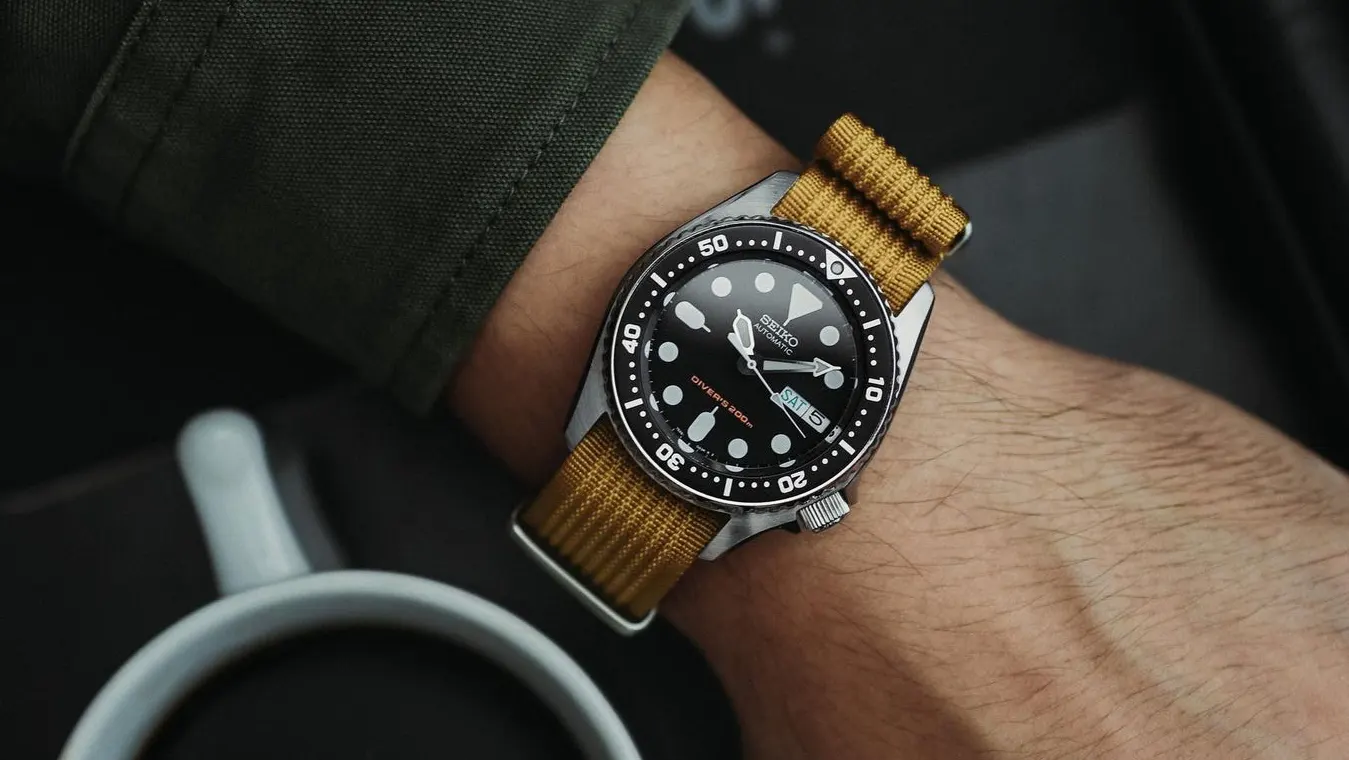
On Wrist
Pictured below on 6.3" (16cm) wrist @apaullowatches.
Chapter Ring Aligned
While not unfixable, look for examples where the chapter ring aligns with the vertical dial markers. Another quick visual check is whether the bezel triangle aligns at 12 o'clock.
This example is misaligned.
Case
The case is satin-brushed on top and polished on both sides of the flanks.
Bezel
The bezel is unidirectional and should have a nice satisfying click.
On Wrist
The “quality control” aspect to look for is the alignment of the chapter ring with the dial markings. Although fixable, if you don’t see it as part of the charm, it is best purchased already aligned.
.
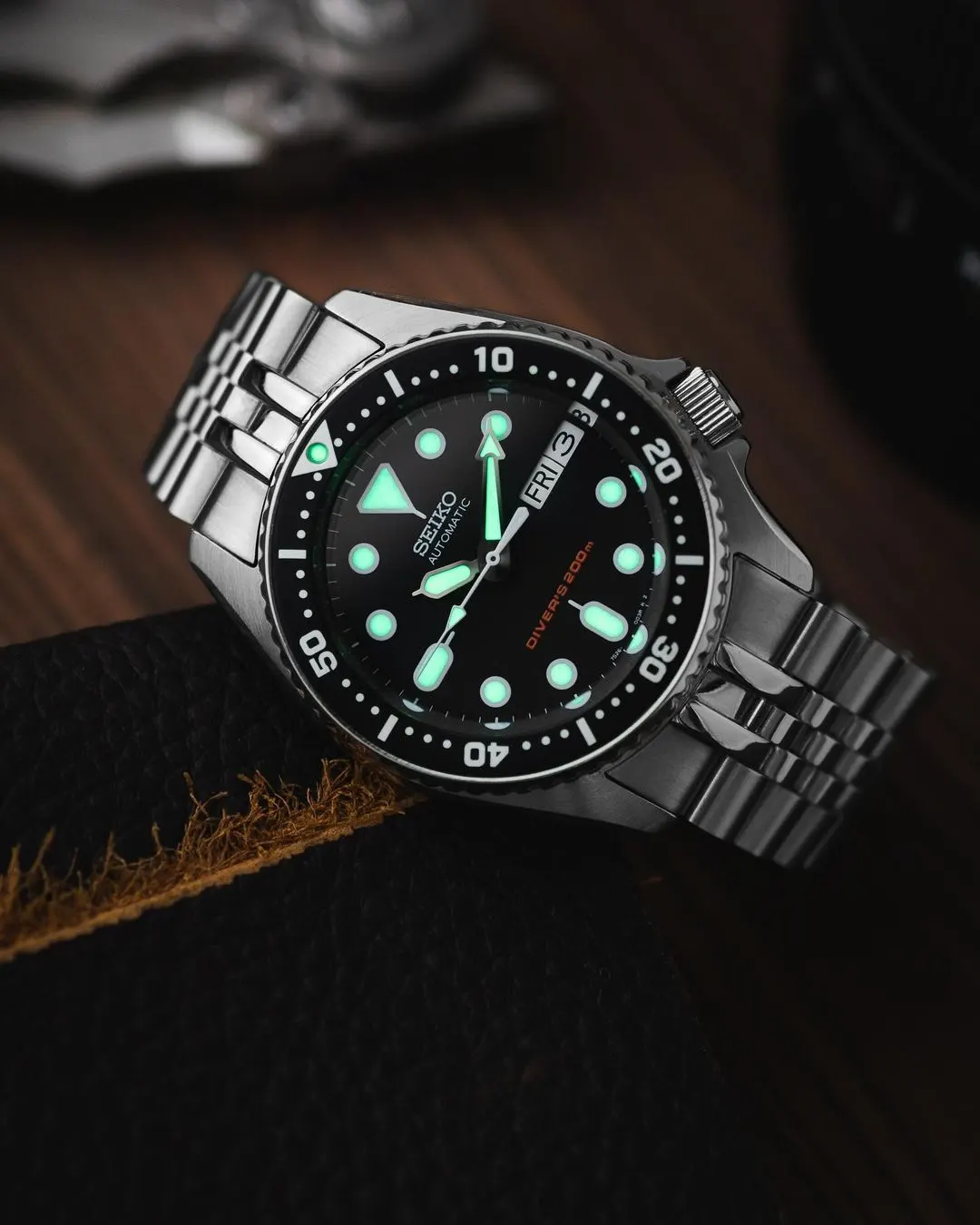
Under the Loupe
Looking beyond the specifications, it’s easy to see where Seiko chose function over refinement. This design philosophy has remained a defining characteristic of Seiko dive watches since the introduction of its first automatic diver, the 62MAS, in 1965.
The dial is a good example. The hands and hour markers are large and easy to distinguish, while generous applications of Seiko’s LumiBrite ensure both remain highly legible after dark. Everything has a purpose, and little feels unnecessary.
The calibre 7S26 movement lacks both hacking and hand-winding, and its accuracy can vary considerably from one watch to another. These aren’t deal breakers, but they are compromises to be aware of.
The Hardlex crystal is another practical choice. Measuring approximately 7 on the Mohs hardness scale (compared with sapphire’s 9), it resists scratches from most objects encountered in daily life, including most steel blades. During my years of ownership, I never managed to scratch it.
The bezel is easy to grip, the crown is tucked away at four o’clock, and the 200-metre ISO certification means the SKX013 is every bit a true dive watch rather than simply one that looks the part.
The Jubilee bracelet is functional and features a signed clasp. To keep costs down, Seiko used push pins instead of screws for sizing.
The compromises Seiko made also gave rise to one of the largest aftermarket ecosystems in modern watch collecting. From sapphire crystals and custom dials to the Super-J Louis bracelet featured in the adjacent image by apaullowatches, replacement and upgrade parts are widely available. Owners can leave the watch entirely original or tailor it to their own preferences.
Taken as a whole, I came away feeling that nearly every compromise Seiko made reflected a deliberate priority: the SKX013 was designed to be used first, with refinement coming second.
.
Under the Loupe – Continued
The date wheel uses blue lettering for Saturday and red for Sunday, a colour convention Seiko has used since the 1960s and which has since become closely associated with the brand.
Beyond its colours, the day wheel was also produced in multiple language combinations for export markets. Rather than manufacturing separate movements for each region, Seiko fitted bilingual wheels that allowed the wearer to select either language by advancing the day display one additional position.
Below is a list of SKX language variants compiled during my research into original SKX day wheels:

English / Japanese
Asia

English / Spanish
Latin America

English / Arabic
Middle East

English / German
Europe

English / French
Europe & Canada

English / Chinese
Greater China

English / Danish
Denmark

English / Roman Numerals
Limited export
Research Note: If you’ve encountered an original SKX day wheel not listed here, I’d love to hear from you.
.
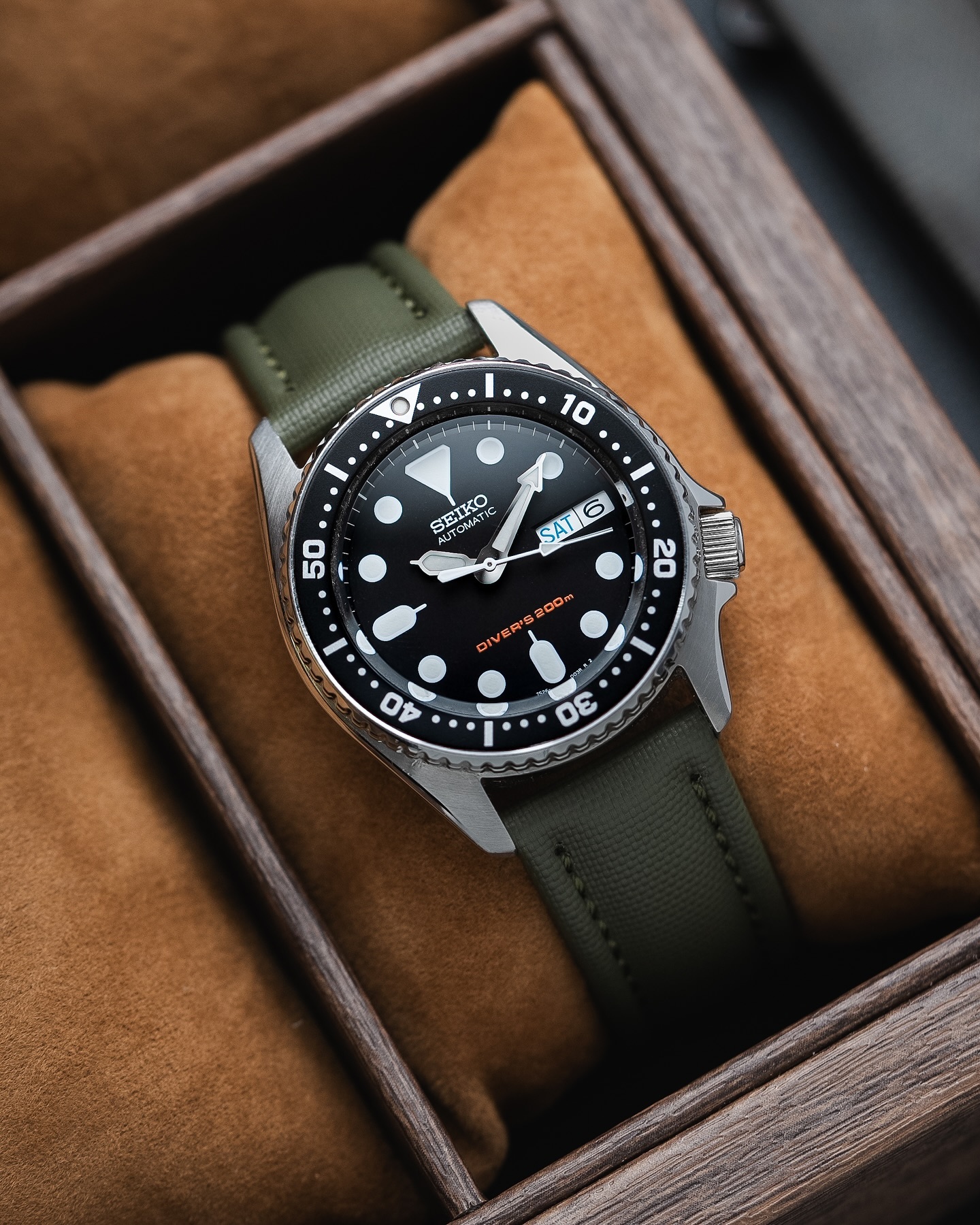
Years Later
I didn’t realize it at the time, but the SKX013 became an inflection point in my collecting journey.
It first taught me that watches are meant to be worn. Because the SKX013 wasn’t an expensive purchase, I never hesitated to wear it. It picked up the occasional scratch along the way, but over time I stopped seeing them as flaws. Instead, they became part of the watch’s story. That shift in perspective has stayed with me ever since and continues to influence how I enjoy every watch I own.
The SKX013 also taught me the value of looking more closely. Over time, I learned that seemingly small details – such as the alignment of the chapter ring – could distinguish one example from another. Mine happened to be well aligned, but it was also one of the first reminders that careful observation is often rewarded. This lesson carried into my later interest in vintage watches. Interestingly, our guest photographer’s SKX has a noticeably misaligned chapter ring, yet he prefers it that way. For him, it’s simply part of the watch’s character.
Perhaps the biggest surprise was discovering how much proportions matter. Despite its modest 37mm case, the broad bezel and relatively tall profile made the watch wear larger than I had expected. I gradually realized that wearability mattered more to me than specifications such as ISO certification. That lesson eventually led me to the Black Bay 58 and later the Black Bay 54, whose slimmer cases and more balanced proportions better suited my wrist. Along the way, I also came to appreciate how much a bracelet contributes to comfort. Today, I consider on-the-fly micro-adjustment essential.
The SKX013 also changed how I thought about movements. While I came to appreciate the convenience of hacking seconds and hand-winding, I also found myself enjoying the interaction required by the 7S26. Giving it a gentle shake before strapping it on became part of the ritual. And that experience later opened me to the often-overlooked appeal of hand-wound watches, where interacting with the movement is part of the enjoyment rather than an inconvenience.
The lessons the SKX013 taught me stayed with me long after the watch left my wrist. As my collection evolved, I assumed it had played its part in my collecting journey. I thought our story together had come to an end.
.
Rediscovered
By then, I had stopped wearing the SKX013. I had intended to sell it, but never got around to it. Instead, it was packed away and largely forgotten.
Four years later, my son Ryan had turned 14 and decided he wanted to buy his first automatic watch with his own savings. While looking through my disorganized tools drawer, he came across the forgotten SKX013.
It became a little project. I shared my experiences, but Ryan made the decisions. Before ordering a single part, he spent weeks reading forum discussions, watching videos, and putting together a comparison chart to decide exactly how he wanted to modify the watch. He addressed the issues I had lived with for years by fitting a thinner caseback, a hacking NH36 movement, a sapphire crystal, and a rubber strap. At the same time, he chose to preserve the watch’s original character, even going so far as to transplant the day-date wheel from the original movement.
Watching my son discover the SKX013 made me realize something I hadn’t appreciated when I first owned it: perhaps because of its flaws, the SKX013 has a way of teaching collectors. It encourages learning, invites modification, and rewards curiosity. Perhaps that’s why different owners seem to take something different from it.
Looking back, I no longer see the SKX013 simply as my first automatic watch. I see it as a watch that helped shape my understanding of collecting, and one whose lessons continue to be discovered by others.
.