
Oyster 34mm vs Explorer 36mm: 114200, 124270
“A watch’s diameter doesn’t tell the full story.”
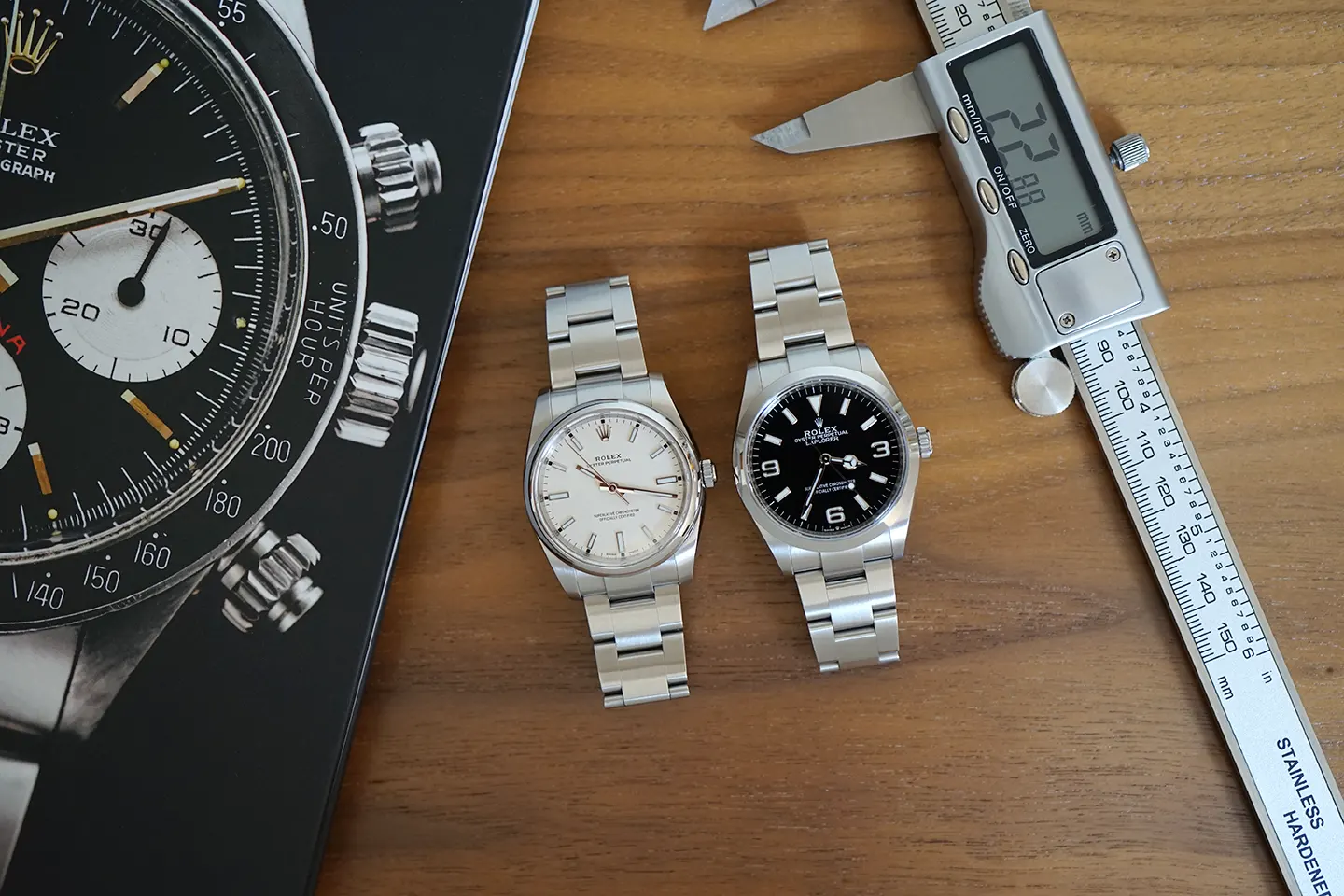
Recently, Edward, a fellow watch enthusiast and seasoned collector, sparked an interesting conversation comparing the wearing experience of the white dial 34mm Rolex Oyster Perpetual 114200 and the 36mm Rolex Explorer 124270.
At first, comparing these two models might seem unnecessary – they occupy different parts of Rolex’s catalogue and were never really meant to compete. But once you wear them and dig into the details, they are unexpectedly alike.
.
Wear and Compare
At first glance, the clear conclusion is that the 34mm Oyster wears smaller than the 36mm Explorer and we should move on, but that’s not the case.
On paper, there are significant differences, but in real life, both feel like 36mm. There are several reasons:
Dial: White dials appear bigger, while dark dials appear smaller. The Oyster’s simpler baton indices create a feeling of space, while the Explorer’s Arabic numerals fill up the dial. Their most critical attribute, the dial dimensions, are both 29mm.
Bezel: The Oyster uses a domed bezel, curving from the crystal toward the case, while the Explorer’s smooth bezel has a flatter, more angular profile. On the Oyster, that curvature allows the bezel to blend into the case; on the Explorer, the flatter surface creates a more defined frame around the dial.
Case: The Oyster case is smaller, but its broader super case silhouette and thicker lugs give a strong presence by design. Additionally, the thinner bezel steps back, allowing the Oyster dial to feel more expansive. In contrast, the Explorer achieves its balance with a thicker bezel and curved lugs.
Bracelet: The larger case and tapered Explorer bracelet (19mm to 14mm) can also make the watch feel smaller. With a wrist size of 6.2”, I do not see a difference, and the Oyster clasp proportions are just right. Larger wrists (6.75” plus) might find the bracelet undersized and want to try out other Explorer 36mm references.
In daily wear, the Oyster Perpetual feels true to its 34mm size, and I find it slightly more comfortable. Despite its smaller case diameter, the Oyster still holds the same presence and visual sizing as the 36mm Rolex Explorer.
.

Differences to Consider
Outside of specs, here are the most important attributes I’d recommend looking at.
Comfort: Of all the watch brands I’ve tried, Rolex produces my favourite bracelets. “Velvety” describes how the metal feels on the wrist. Equipped with an EasyLink, the Oyster pulls ahead in comfort. As a side note, both bracelets are the most comfortable in my entire collection.
Cost: At MSRP and Grey Market, the Oyster Perpetual is more affordable. Though the Oyster 114200 had an unusually short run (2 years), 34mm-sized watches are often overlooked and priced better at resale.
Versatility of Wear: With 100 metres of water resistance and a low-key look, both watches can be worn anywhere. Of the two, the Oyster Perpetual is the more versatile. It fits better under a formal (tighter) cuff and, being more neutral, works better across formal, business casual, and weekend wear. On the other hand, if you rarely dress formally, I’d recommend the Explorer.
Availability: In Dec 2021, the Rolex Explorer was readily available “for Rolex” and, from what I’ve read, still has “reasonable” wait times through Authorized Dealers. However, there are no white dial Oyster Perpetual references currently in production.
Partner: These watches are classic in design and proportions with universal appeal. If your partner has a similar wrist size, your significant other might be able to borrow your watch. In my case, my wife wears my Oyster over a sweater for the right fit.
.
Leather Straps
The topic of leather straps paired with these watches deserves special mention. Neither watch is optimized for leather straps.
Once removed, the same male end links that make the modern Oyster appear larger have the opposite effect. In addition, it just looks plain awkward. Google images “Rolex 114200 on a leather strap” and the Internet agrees showing only a handful of examples, if any.
The Explorer traditionally looks great on straps. However, the 124270 introduced recesses between the lugs and moved the spring bar holes closer to the case. Specialty straps with curved spring bars might still fit, but you’ll still see the indentation at certain angles.
The only strap configurations I recommend would be specialty integrated rubber straps or curved spring bars with NATOs. As an engineer, I’d also hack my strap clasp with a Rolex EasyLink.
Having said all that, both watches are best on a bracelet. I would go so far as to recommend never putting either of these references on strap.
Dial and Crystal
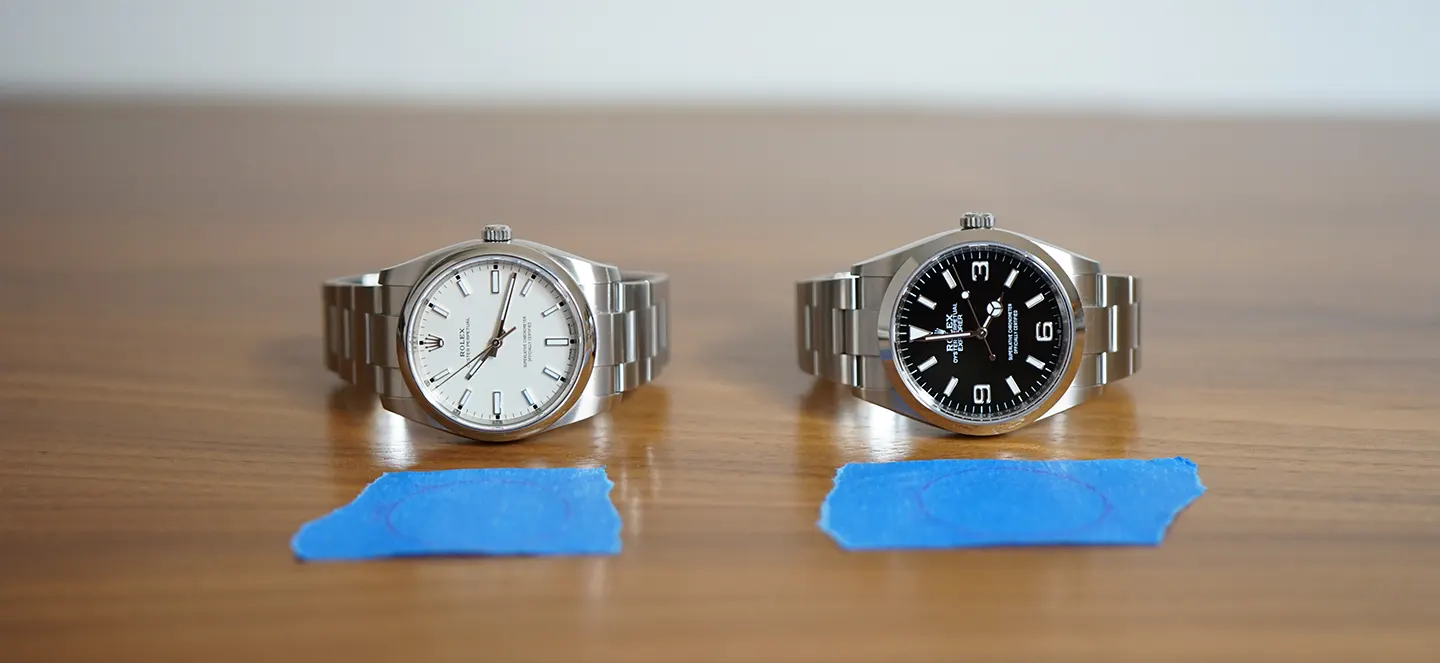
The most critical attribute is the dial dimension; both are unexpectedly the same at 29mm in diameter.
Exact Measurments
Frottage imprints (using painter's tape and a pencil crayon) reveal both crystals measure 29mm.
.
If I Had to Pick
I compiled this weighted comparison table wondering which one would come out on top. The full spreadsheet is also online to try yourself.
Weight and Points Score 10 (High) and 1 (Low)
As a paper exercise, my priorities placed the Explorer “If I had to Pick”, but only by a tiny margin.
.
Other Explorer References
Because Rolex has kept the Explorer’s design largely unchanged over the decades, there are now multiple visually similar references available in different sizes and price ranges.
As of July 2024, the 36 mm Explorer ref. 14270 (1989–2001) could be found for as low as US $4,200, and the 36 mm Explorer ref. 114270 (2001–2010) for about US $4,700 — both coming in cheaper than the Oyster Perpetual 114200 at US $4,800.
Meanwhile, the 39 mm Explorer ref. 214270 (2010–2021) and the current 40 mm Explorer ref. 224270 (introduced 2023) offer larger-case alternatives for those seeking more wrist presence.
There are slight generational differences, but these older references still provide a modern “Explorer” wearing experience, often at a more accessible price point.
.
Closing Thoughts
When it comes to watches, a difference of 2mm can feel significant. Yet throughout this comparison, the Oyster Perpetual 34mm and Explorer 36mm demonstrated how wrist presence is shaped by more than diameter alone.
The Explorer’s bold 3-6-9 numerals and matte dial create a stronger visual structure. In contrast, the Oyster 34mm counters with its boxier, maxi-style case and lighter dial, allowing it to wear larger than its 34mm specification and present with a more balanced wrist presence.
In the weighted comparison earlier in this article, the Explorer came out slightly ahead, largely due to its visual structure and purpose-driven design.
Yet the Oyster 34mm is the watch I reach for more often, particularly for my workday. That doesn’t mean it receives the most wrist time. The Explorer 124270 tends to stay on my wrist longer and remains my most-worn modern watch. It’s a distinction I didn’t appreciate when I first compared them: how often I choose a watch and how much I ultimately wear it aren’t quite the same thing.
Case diameter remains an important indicator of fit on the wrist, but this comparison also highlighted how overall design and proportions can influence daily wear just as much. Going through this detailed comparison has made me more open-minded toward pieces I might normally overlook, particularly those where presence is shaped by design rather than size alone.
I hope this comparison has been useful. I’d also be interested to hear how others experience these models, particularly those who have spent time with both.
.