
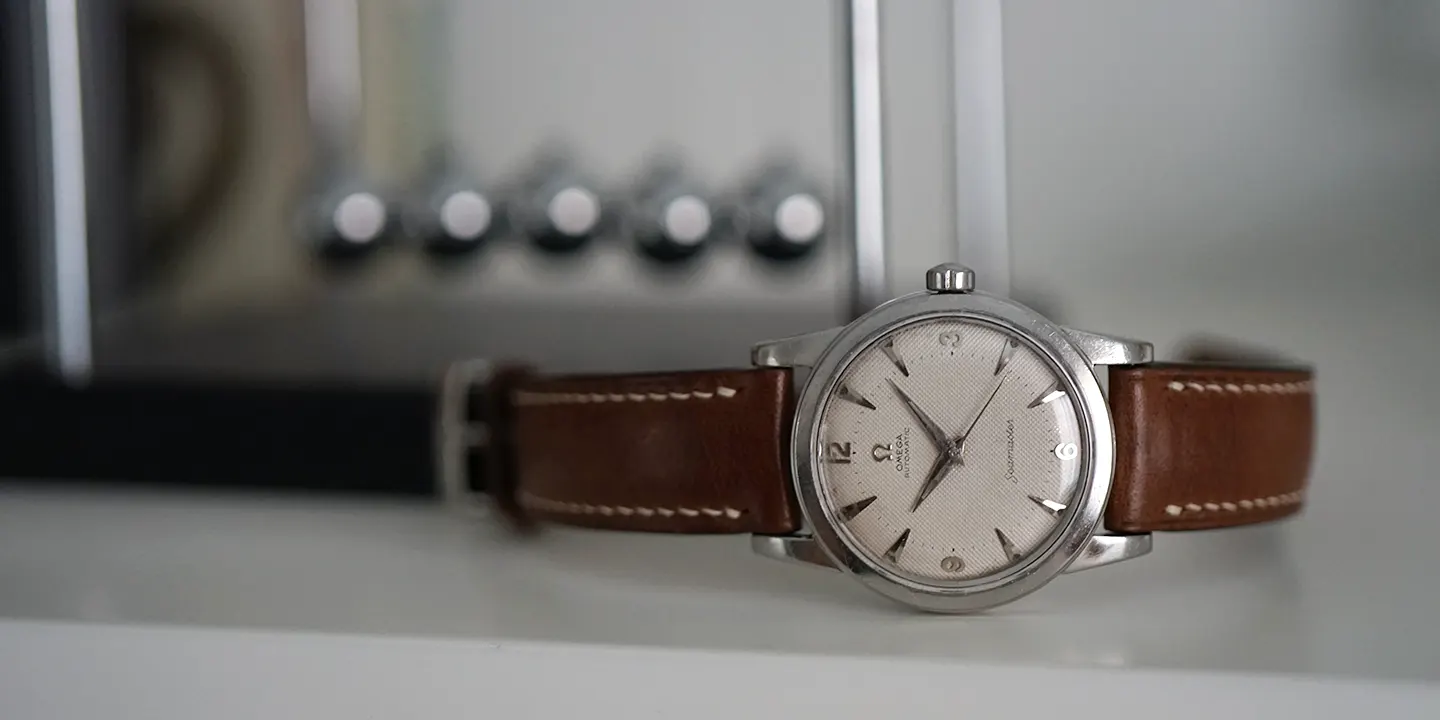
Omega 1952 Seamaster, White Honeycomb 3,6,9,12, 2577-11
“Acquiring my first grail and the charm of an automatic bumper.”
My first “grail watch”.
It took me two years of hunting to come across this particular Seamaster.
Aside from the honeycomb dial, this watch represents the core DNA of Omega’s first lineup of Seamasters, originally issued in 1948.
The Seamaster debuted after World War II as a dress watch for the gentleman. Its durability and reliability were proven during wartime, as it was issued to the British Royal Air Force and Navy.
This is my most-worn vintage, right next to my Rolex Explorer 5500.
As I’ve written about my similar Seamaster 2846-2848 before, here I’ll focus instead on the wearing experience and its bumper movement.
Specifications
- Model: 1952 Seamaster
- Reference: 2577-11 SC
- Movement: Automatic Bumper Caliber 351 in-house, non-hacking, 17 jewels, 19,800 vph, non-magnetic
- Power Reserve: 42 hours
- Dial: White cream honeycomb dial, original dauphine hands, with aged grey radium lume
- Case: 34.5mm, 43.5mm lug-to-lug, Omega signed crown
- Thickness: 11mm
- Crystal: Domed signed plexiglass
- Lug Width: 18mm
- Favourite Strap Pairing: Delugs Tan Barenia Signature
Acquired: Feb. 2, 2021, through Those Watch Guys.
Service History: Dec 2023 by Illya, Gold Time Horology
.
Why I Got It
In addition to my dressy numeral 12 Seamaster, I was looking for a more quintessential variant as a daily wear.
Though I normally prefer clean dials, I liked how this one aged with a slight patina around the edges. Combined with its simple, worn-in case, the watch felt just right for everyday wear.
Historically, this watch closely embodies the DNA of the original Omega Seamaster introduced in 1948. The CK 2577 (featuring a center seconds hand) and CK 2518 (with a sub-seconds dial) were among the closest successors to the original design and remained in production until 1955.
Having said all that, what drew me in the most were the silver 3, 6, 9 and 12 applied Arabic numerals.
.
How It Wears
These Seamasters are often classified as half-dress and half-casual. However, I’d say this reference leans casual and best paired with jeans and a t-shirt. The masculine design and unpolished case exude a ruggedness appropriate to its era.
Like the original 1948 model, this one also has a bumper movement. Though it might not be as efficient in winding, there’s a certain charm in the feel and sound of the bumping motion. Much like a jangling bracelet, it contributes to a distinguished vintage-wearing experience.
Despite its 34.5mm diameter, the lugs, white dial, and oversized crown give this watch a commanding presence. I find it sits best on wrists ranging from 5.5″ to 6.5″. The downward-sloping lugs create a visual hug on my wrist, but those on the larger wrist size should try one on before buying.
.
What to Look For
As I’ve covered most of this material in my Seamaster 12 post, here I’ll instead focus how I searched for the reference number and the bumper automatic movement.
Chamfers
Case, chamfers and lugs can indicate polish history.
Crystal
Omega crystals are domed plexiglass and have an etched logo at the center. Don't fuss over their condition. Light scratches can be polished with Polywatch or the crystal replaced at a nominal fee.
Honeycomb Dial
The camera lens reflection can look like water damage. Ask for photos from multiple angles and under natural light.
Signed Clover Crown
Look for the raised Omega logo on the clover crown.
Strap
Vintage Omega's look great on straps. I only buy those with quick release like this Brown Buttero Slim.
Searching for the Reference Number
I started by using image search for Google and Bing, where you upload a picture of your Grail watch. This helped me narrow down the overall reference number to 2577.
Though the Omega Database did not have the exact model, it gave a fair reference point, notably suggesting the movement might be a 351 or 354.
If you know how to open your watch, additional details are often on the base back and the movement itself. This watch’s case back reads “2577-11 SC”, which breaks down to,
2577 – Confirmation of the model, also known as the reference number.
11 – Dial configuration, design, or other aesthetic details.
SC – Stands for “Seconde Centrale”, meaning centre seconds as opposed to small seconds.
In some cases, watches made until the early 1960s, the material codes written to proceed ahead of the 4-digit reference:
- CK/MI – Steel
- OT/OJ – Solid Gold
- KO – Gold Cap
- PK – Gold-Filled
The serial number on the movement confirmed the year of production to be in the range of 1952.
Finally, to confirm the movement, you can sometimes find a number, but in my case, I used image search to conclude it as a 351.
Omega Bumper Movements
The bumper, also known as the hammer movement, was invented in 1923 by John Harwood and is the first generation of automatic (self-winding) wristwatches. The key component was a rotor (oscillating weight) which swung back and forth within an arc, limited to 300 degrees. With spring bumpers on each side, the rotor’s kinetic energy powered the watch by winding the mainspring.
The bumper design was necessary because, at the time, watch movements could only be wound one way. With this limitation, it was necessary to have a ratchet mechanism optimized with a restricted arc. The rotor would then swing against the bumpers, which guaranteed engagement with the ratchet wheel teeth that only rotated in one direction.
It was in 1931 that Rolex iterated on this design and patented the current generation of central rotor automatics. Rolex introduced reverser gears (allowing the mainspring to be wound in both directions) and, with that, a full 360-degree rotor. However, the basic mechanics (movement transferred to an oscillating weight connected to gears to wind) largely remained the same.
Due to Rolex’s patent, which expired in 1948, bumper movements continued to be improved and produced by other watch manufacturers. In Omega’s history, bumper movements were introduced with the calibre 28.10 in 1943, with the last calibre 355 produced up to 1962. In parallel, Omega introduced its first full-rotor movement, the calibre 470, in 1952.
Ins and Outs of Bumper Purchases
There is some FUD (fear, uncertainty and doubt). This is largely driven by forum posts stating that bumpers have more wear and tear and are harder to service. However, bumpers are a great value proposition, especially in the context of vintage everyday wear and their historical significance.
As the table shows, there are negligible differences aside from the feel of the bumper movement.
.
Under the Loupe
The 2577 reference was produced in large quantities between 1948 and 1955. Perhaps due to the era of change, you will find a staggering diversity of dials, movements, case backs and crowns. This is a great reference to start with, as you will likely find something that suits your tastes.
I had this watch serviced in December 2023 by Illya of Gold Time Horology, known for his stellar reputation in handling vintage watches. I was not disappointed.
Illya sourced a brand-new Omega signed domed crystal, replaced the crown (using my used but better-condition spare) and gave sound guidance on what changes to avoid.
The calibre 351 movement holds historical significance as part of Omega’s final series of bumper automatic movements. The subsequent calibers, 354 and 355, represented the last in this line, with the 354 being chronometer-certified and the 355 introducing a date complication.
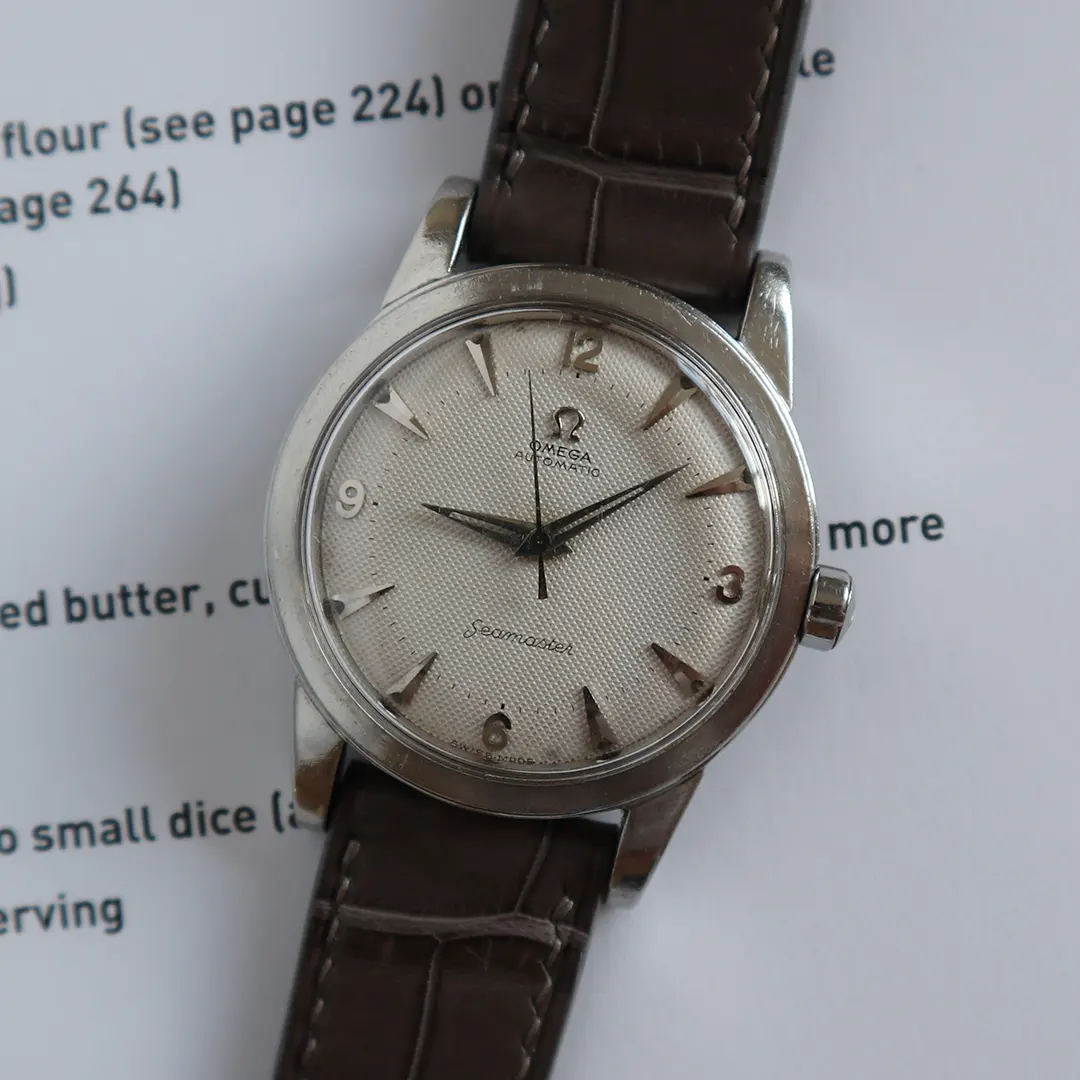
The dial has aged gracefully; the radium lume on the applied arrow markers has turned a soft grey. The hands no longer have lume, but I actually prefer it that way – it feels more age-appropriate and in keeping with the character of the watch. A watchmaker can restore it with non-luminous and colour-matched paste, or specialized watchmakers can utilize scrapes from donor watches.
The 2577’s steel cases came in two styles. This one, unlike my later 1955 Seamaster with its chamfered lugs, features a slim, polished edge that lends it a casual presence. Add in the well-worn patina and drilled lugs, and the case exudes a rugged, no-nonsense casual character.
I’m usually a “perfect” dial collector, but the imperfections in the honeycomb texture are just more suitable here.
Having said all that, what captivates me the most are the silver 3, 6, 9 and 12 applied Arabic numerals.
.
Years Later
Now, in 2024, this Seamaster remains my most-worn vintage Omega. It’s the perfect combination of design, history and patina for everyday casual wear.
.
Where to Buy
Unless you’re new to vintage watches, I would recommend avoiding eBay initially. The risks involved with authenticity and condition can be significant.
If you are a first-time buyer in North America, take a look at the Omega Enthusiast (based in Canada). He offers some of the cleanest dials I’ve seen. His photos are very representative of the watches condition as he makes a point to take his photos in natural daylight. The watches are also meticulously serviced, warrantied, genuine and finally discounted – for life – for future services.
For the more Internet-savvy, I recommend the Omega Forums private sales. The community culture and the presence of Omega specialists create an environment of learning, authenticity, and fair pricing. Focus on buying the buyer, and start with established reputable forum members.
Finally, for a greater selection, often on these forums, you might also consider professional watch dealers. I’ve also had great vintage purchases from CoinWatchCo, Cape Town Vintage Watches, Horology Hour and Those Watch Guys.
This particular watch was purchased from Those Watch Guys.
.