
Cartier 2022 Santos-Dumont Lacquer, Steel WSSA0046 and Rose Gold CRWGSA0054
“It’s simply one of my favourite and most interesting timepieces in my collection.” Vern
I didn’t consider Cartier a watchmaker in the same way as Rolex or Omega. It sat in a different category – a jewellery house that also made watches.
The Santos-Dumont lacquer changed that. Learning its lineage, tracing back to the first purpose-built aviation wristwatch in 1904, and spending more time with the broader history of the model, shifted how I thought about both the watch and Cartier’s place in watchmaking.
In this article, Verne Ho joins with his rose gold reference alongside my steel – two executions of the same design, worn and interpreted differently. A Cartier collector and photographer (@watchstudies), his work documents both watches in use.
Specifications
- Model: 2022 Santos-Dumont Large
- Retail Price: $4,400 USD / $10,300 USD (in 2022)
- Reference: WSSA0046 or WSSA0068, CRWGSA0054
- Movement: Manual-winding Caliber 430 MC, 18 jewels, 21,600 vph, non-hacking
- Power Reserve: 38 hours
- Dial: Engraved Lacquer Dial in Black / Cream
- Bezel: Lacquer embossed, Steel / Rose Gold
- Case: 31.4mm x 29.8mm (L x W), 43.5mm lug-to-lug, decorated case back, studded crown capped with blue/red cabochon
- Thickness: 7.3mm
- Water Resistance: 30m
- Crystal: Domed signed plexiglass
- Lug Width: 17mm
- Strap: Alligator in Matte Black or Black Calfskin / Dark Green with Cartier Signed Buckle (steel / 18k rose gold) with QuickSwitch
- Produced: 2022 onwards
Acquired: Jan. 9, 2024, in trade with The 1916 Company.
.
Why I Got it
Like many watch enthusiasts, my journey began with sports watches. After adding a vintage Movado dress watch, I thought my collection was complete. It worked well in most office settings, but felt slightly out of place with modern, darker business wear – particularly in the evening.
I was looking for something slim enough to slide under a cuff, understated in presence, but able to move between daytime office wear and more modern, evening-leaning outfits. Enter the steel black lacquer Santos-Dumont WSSA0046.
“I was immediately drawn to the new line of lacquered Santos-Dumonts as a modern, fun, and tasteful re-interpretation of one of Cartier’s most iconic timepieces. While my heart was initially set on steel and black lacquered reference for its versatility and elegance, my wife and SA rightfully nudged me in the direction of the rose gold and vanilla-lacquered reference instead. The subtlety of the vanilla lacquer against the warmth of the rose gold case has to be one of the most dynamic tonal pairings I have ever come across on a timepiece. Every turn under a light offers something a little different. It’s simply one of my favourite and most interesting timepieces in my collection. And I nearly missed out on it.” Verne
I was still deciding at that point. Heritage is not usually a major factor in my buying decisions, but in this case, it played a quiet role. The Santos-Dumont sits at an interesting point in early aviation and watch design – a product of friendship, function, and a period of rapid modernization where ideas about what a wristwatch could be were still forming. That context made the watch feel more meaningful as my first Cartier.
.
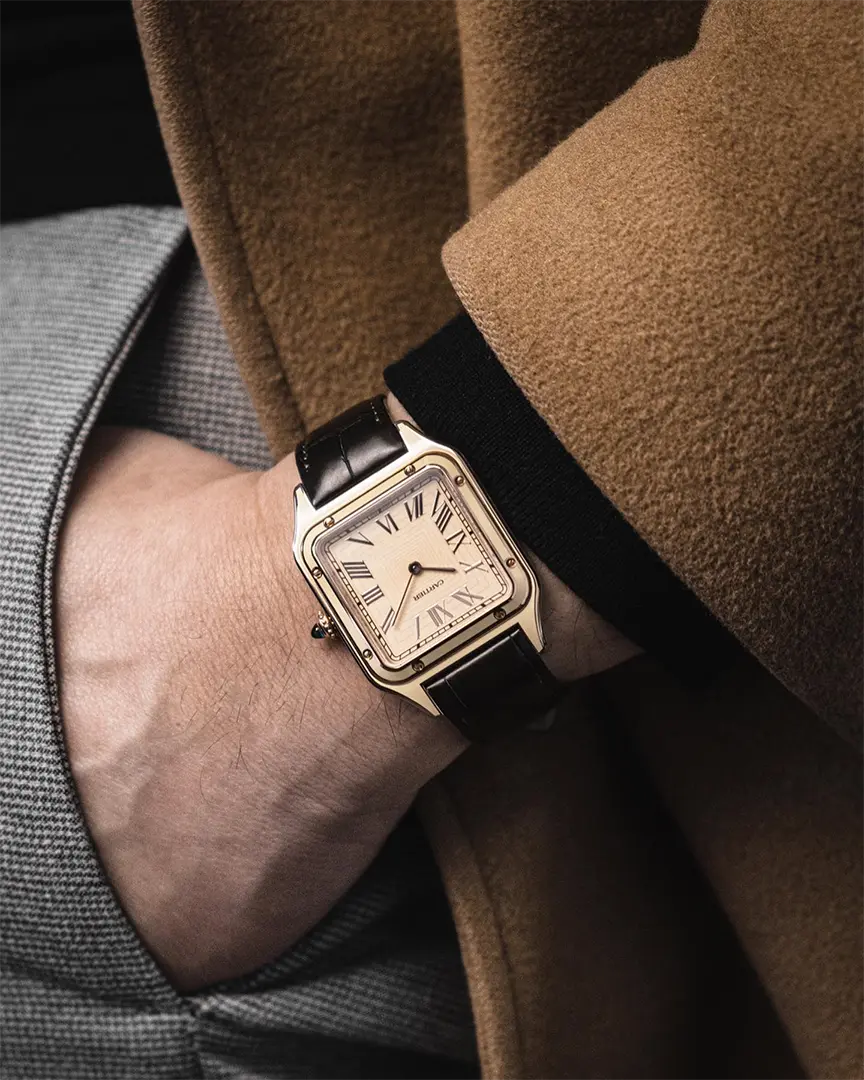
How it Wears
The two Santos-Dumonts wear differently on the wrist.
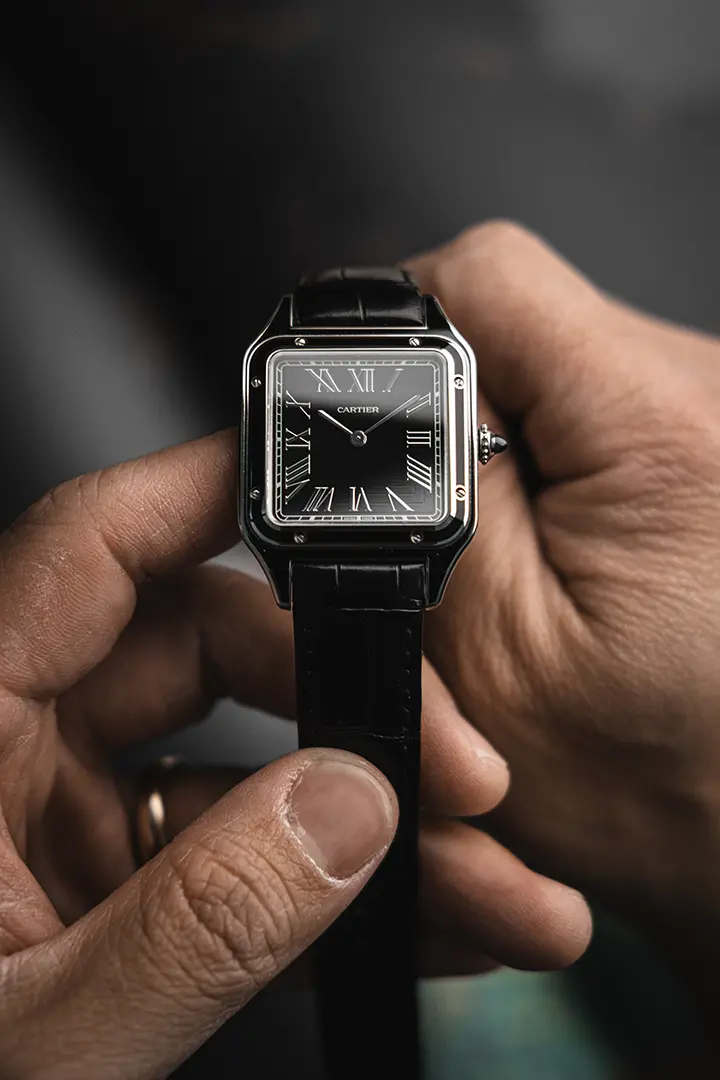
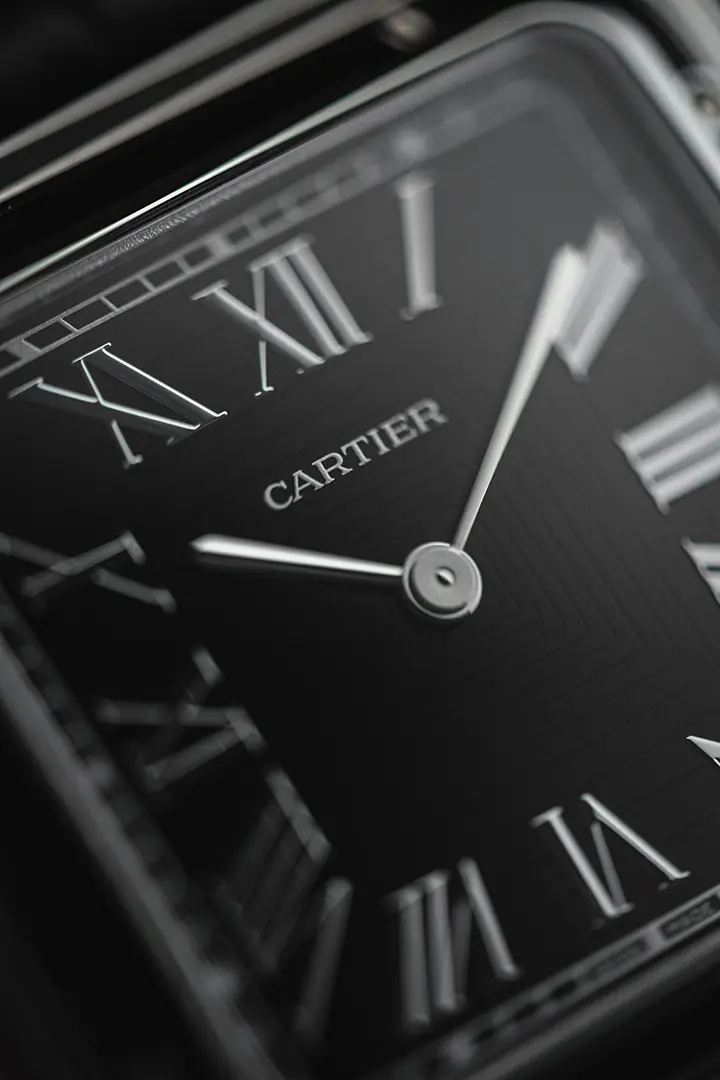
The steel with black lacquer has a sharp presence. In daylight, the engraved square pattern on the dial becomes the focal point, emerging only when the light hits at the right angle. As light fades, attention shifts to the case, where the lacquer accentuates the geometry and edges of the design.
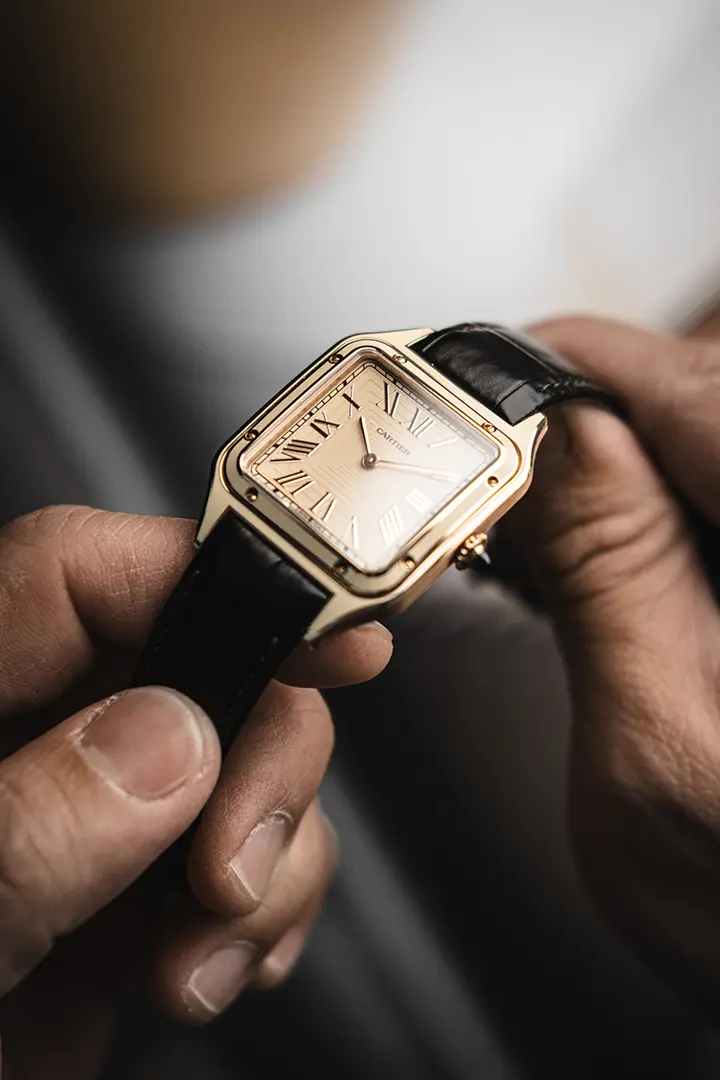
The rose gold with warm cream lacquer feels different on the wrist. It is equally versatile as the steel, but the gold inlay blends more naturally into both case and dial, softening the separation between elements and creating a more continuous impression as it moves between lighting conditions.
“It’s far from being like anything else I’ve ever owned. It is both indulgent and refined while leveraging the classic design language that brings me even closer to the history that had me head over heels for the Santos to begin with. By every definition, it is a special occasion watch but surely one that I’ll make excuses to wear every day.” Vern
Colour harmony principles place steel against cooler and neutral undertones, while rose gold sits more comfortably against warmer tones. In my experience, this held true. Both watches looked great on Verne’s wrist, but on mine, the rose gold felt less natural against my skin’s cooler undertone compared to the steel.
.
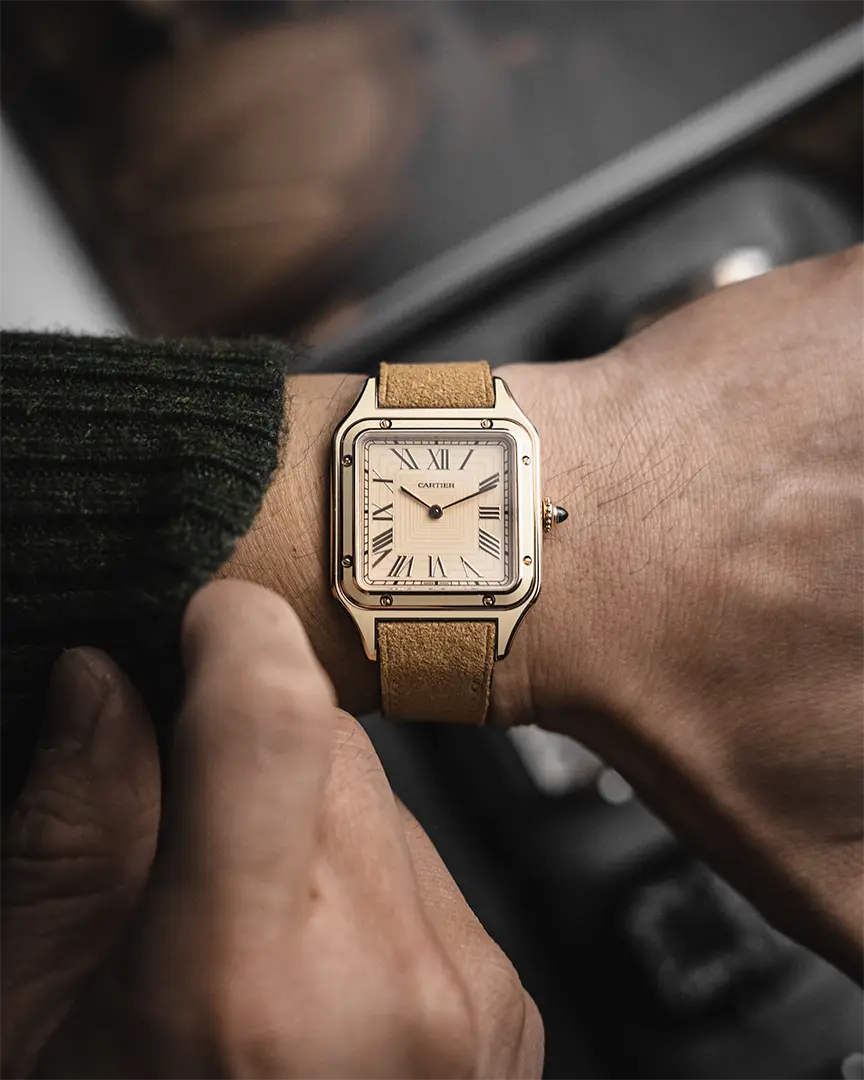
The alligator straps are some of the thinnest I’ve seen. They arrive quite stiff but soften with wear and become much more comfortable. The combinations feel deliberate: steel with glossy black, and rose gold with dark green, each reinforcing the character of the case without pulling attention away from it.
Cartier executes quartz movements well, but the manual-winding movement feels especially appropriate here, offering a small daily moment to engage with the watch. Just like the original, there is no second hand, which keeps the watch on the more formal side.
Despite the “large” designation, the Santos-Dumont wears more compact than its stated measurements. At 7.3mm thick, it sits flat under a tight shirt cuff. Due to the polished highlights, the steel black lacquer reference avoids the visual shrinking effect of dark dials, appearing only slightly smaller than the rose gold cream dial.
Cartier timepieces are often discussed as “ignoring conventional wrist-size rules”. On my 6.2” wrist and Verne’s 6.3” wrist, the Santos-Dumonts feel equally well-proportioned and balanced.
The same balance carries naturally into more casual settings.
.
How it Wears – Casual
In casual settings, the Santos-Dumont stays composed and unobtrusive, sitting comfortably within smart casual. It pairs naturally with classic, slim-fitting T-shirts and jeans.
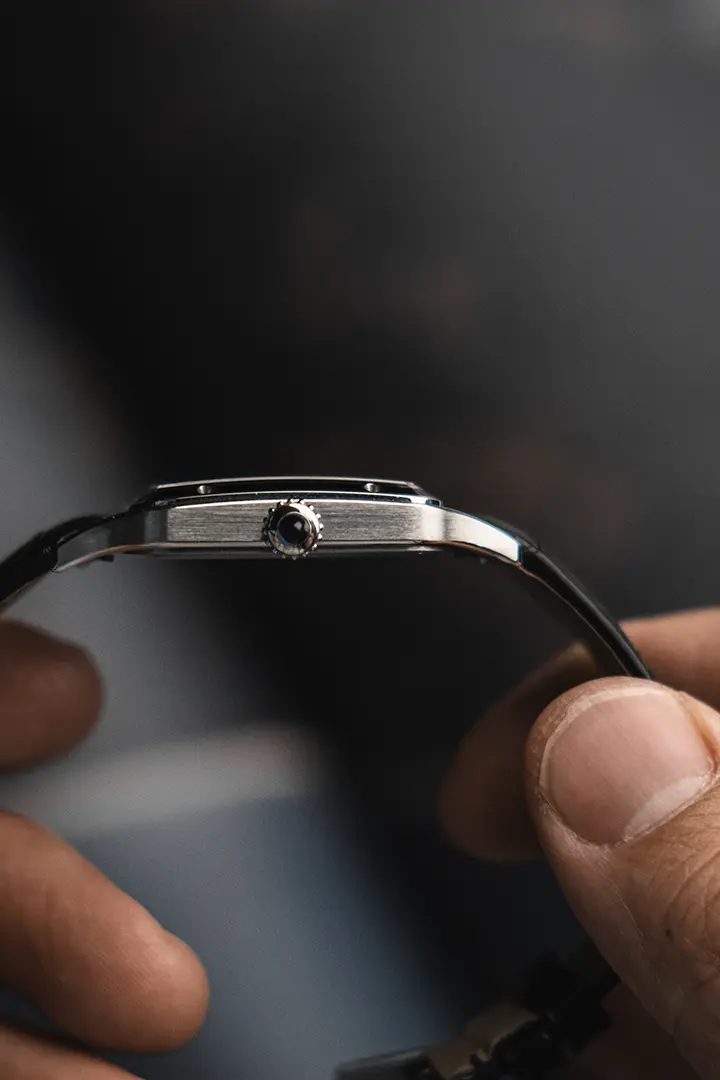
The exposed screws anchor the design with a defined, industrial edge – perhaps a subtle nod to early aircraft construction or the steel framework of the Eiffel Tower. This detail grounds the Stantos-Dumont, keeping it from feeling overly delicate in casual settings.
The steel carries a subtle tension. The black alligator strap introduces a degree of formality, set against otherwise casual clothing.
“The gold unintuitively dresses down when paired with a rubber strap, which nobody in their right mind would ever think to do. If you’re up to having your perspective changed though, try it with Delugs rubber cut-to-size straps and you’ll unlock a whole new set of personalities.” Verne
The subtle tension can work against the watch too. I purchased a Serpentine Grey Ostrich strap to dress down, only to find it worked better with business casual (blazer, dress shirt, and dark jeans) in the office.
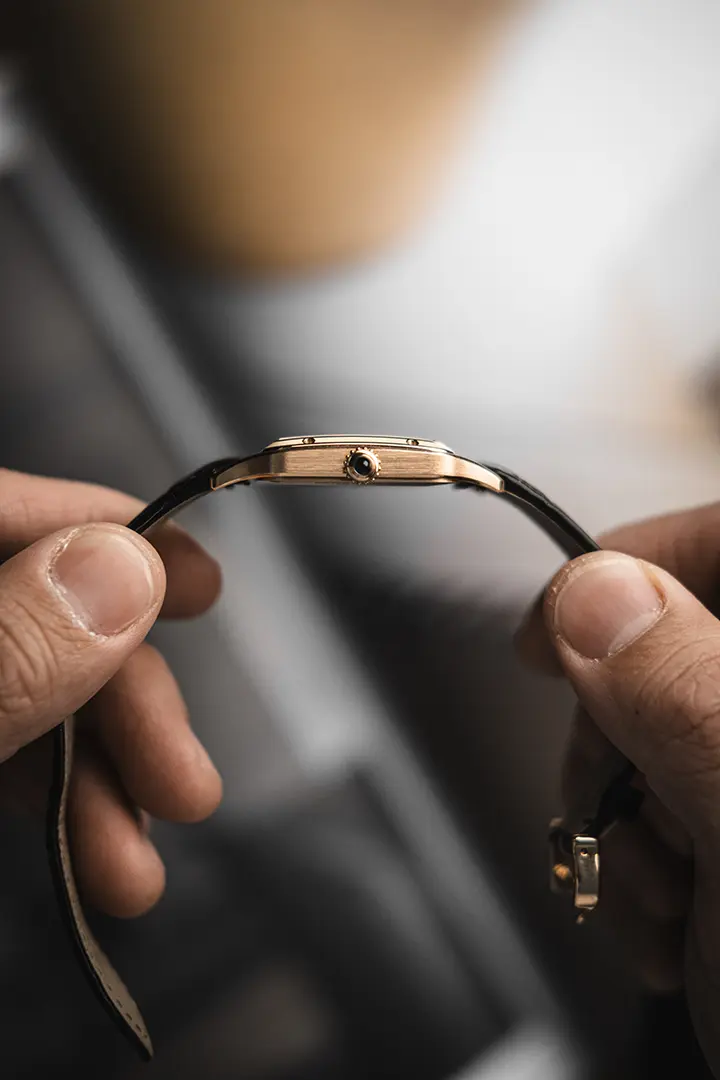
The gently curved case and smooth caseback engravings reflect Cartier’s attention to comfort. Over the course of a full day, the watch maintains a light, unobtrusive presence on the wrist.
.
Heritage
When I acquire a vintage watch, I like to understand how it connects to the past – its context, significance and the people who might have worn it. There are always interesting stories. However, learning about the Cartier Santos-Dumont left me both awestruck and frustrated. Awestruck that this was the first convergence of the gentleman’s tool and aviation wristwatch, whose square-cased design became unmistakably Cartier. Frustrated by the scarcity of detailed historical studies available.
Appreciating its importance requires looking more closely at the period that shaped it.
Let’s set the stage: The early 20th century was a period of rapid change. Cities glowed with new electric lights, automobiles shared roads with horse-drawn carriages, and aviation moved from science fiction to reality. If the 19th century was an era of discovery, the 20th was one of invention and industrialization, defined by groundbreaking advancements, cultural revolutions, and shifting geopolitics. Against this backdrop, Cartier introduced the Santos-Dumont – a watch shaped by function, friendship, and a new way of thinking about timekeeping.
Below, as a visual tour, are key moments in its development.
1901 - Race Against Time
Alberto Santos-Dumont, an aeronaut, sportsman and inventor, challenged the Coupe Deutsch de la Meurthe, a 30-minute 22.6-kilometre air race flying from Paris’s Parc de Saint-Cloud to the Eiffel Tower and back.
“... thousands of people turned out to watch him circle the Eiffel Tower in his innovative airship. The crowds on the bridges over the Seine were so thick that people were shoved into the river when they scaled the parapets to get a better view. (Hoffman 2)”
Human flight was still in its infancy, and Santos-Dumont’s demonstration of controlled, powered flight captured public attention.
1904 - Birth of the Modern Wristwatch
During a dinner conversation, Santos-Dumont described the difficulty of checking a pocket watch while piloting. “His hands were so busy with the numerous cords and controls that he could not pause to take out his pocket watch. (Hoffman 217)”.
In response, Louis Cartier designed a wristwatch with integrated lugs, a leather strap, a square case, exposed bezel screws, and a cabochon-set crown.
It marked the emergence of the aviator’s wristwatch, purpose-built as a functional instrument for flight.
1906 - Aviation Heritage
Santos-Dumont made history with the first publicly witnessed powered heavier-than-air flight aboard the 14-Bis of his own making.
He was as well known for his style as his engineering. Santos-Dumont “was a fixture in the Paris skies” (Hoffman 3) and captured the imagination of the world. In his one-man airship, he could be seen flying down the Paris boulevards and tying his Baladeuse (Wanderer) to the gas-lamp posts in front of the city's many glamorous night spots (Brickel 60).
His visibility helped normalize both aviation and the idea of wearing a watch on the wrist.
1911 - From Tool to Cultural Object
The aptly named “Cartier Santos” was formally commercialized in collaboration with Edmond Jaeger (now Jaeger-LeCoultre), who provided the movement. Though the “watch on wrist” came in 1571 (as a bracelet worn by Queen Elizabeth) and later (jury-rigging pocket watches or wristlets) in the military (1880s, 1850s), it was not a societal norm.
“... men across Paris modelled their hats and clothes after his...” (Wings of Madness 0:23:50)
Worn by one of the most “interesting men” of the era, the Santos-Dumont became a functional and fashionable must-have.
1978 - Modern Reinvention
Cartier relaunched the Santos-Dumont as the “Santos de Cartier” with steel and gold, an integrated bracelet, quartz movement and a raised bezel with visible screws; a more pronounced industrial aesthetic.
Among the first two-toned luxury sports watches, it reflected a cultural shift toward pragmatism and prestige
Cartier helped redefine modern affordable luxury while moving past the last vestiges of the quartz crisis.
Across these moments, the wristwatch moves from technical object to something more visible in everyday life.
From its inception as a tool watch designed for aviation and among the earliest men’s wristwatches tied to flight, the Santos-Dumont sits within a broader 20th-century shift in which modern timekeeping, visibility, and public life began to converge – helping establish the wristwatch as something worn, understood, and read as both an instrument and a marker of personal identity.
It’s also a story of two individuals – Louis Joseph Cartier, a visionary with a deep appreciation for watchmaking, and Alberto Santos-Dumont, an adventurer drawn to flight – whose collaboration produced a watch that still feels distinct more than a century later.
.
Under the Loupe
Across generations, Cartier’s watch designs have evolved while retaining a consistent identity.
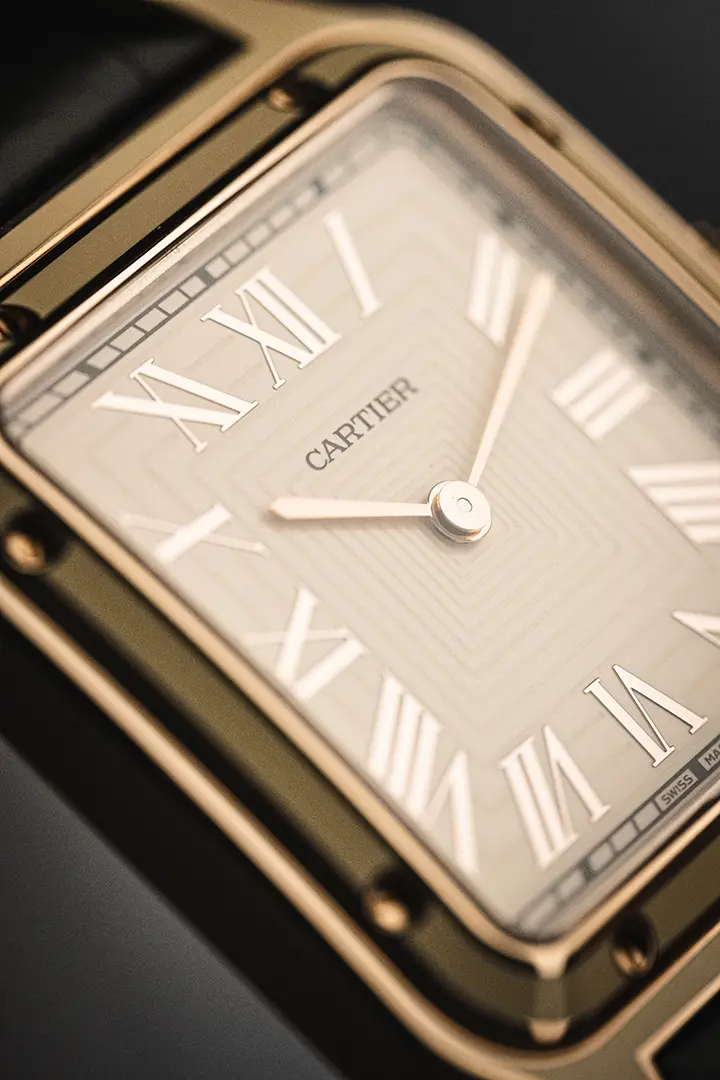
“Legend has it, the rose gold and vanilla lacquered design almost didn’t make the cut. Understandably so, compared to the steel and platinum colour pairings, juxtaposing a creamy beige tone against rose gold just doesn’t sound right on paper. But once you see it in the metal, it hits on a whole other level.” Verne
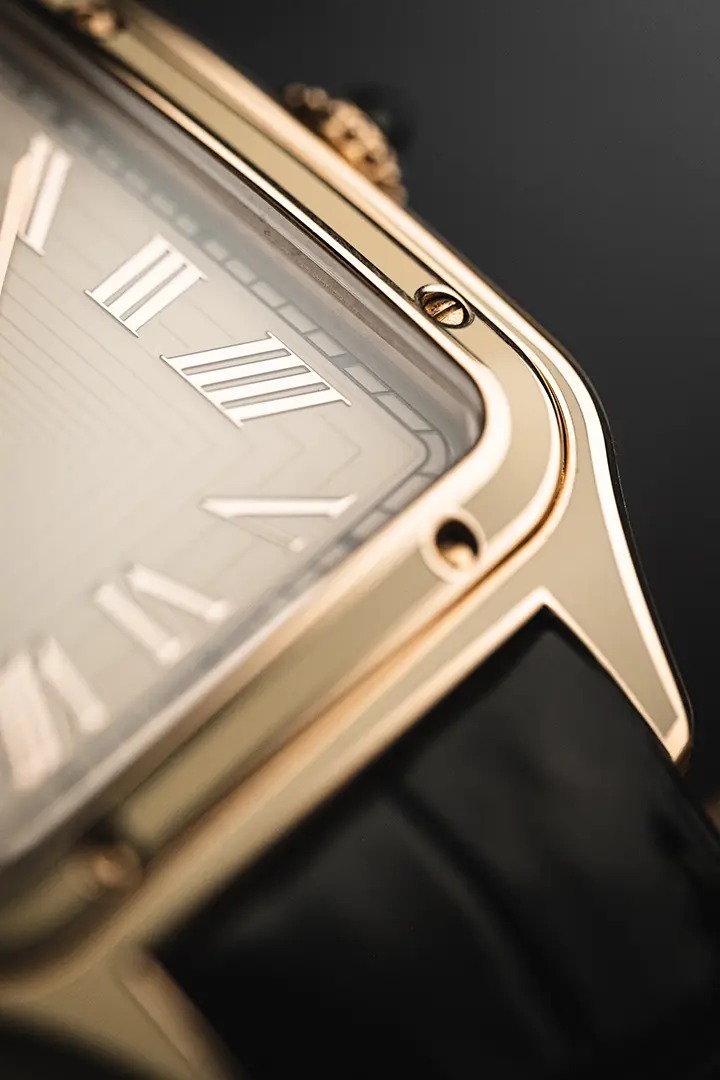
The lacquer dial, set beneath a curved sapphire crystal, features concentric squares that add depth to the glossy backdrop. On the steel, the dial reads as solid black with subtle depth. Up close, it’s an intricate pattern that becomes apparent depending on how it catches the light.
“In gold, the cream is more subdued, but similarly is a study of revealing details over inspection.” The lines creating the concentric squares are engraved; a meticulous hand-finishing process of layering, curing, polishing and specialized machinery.” Verne
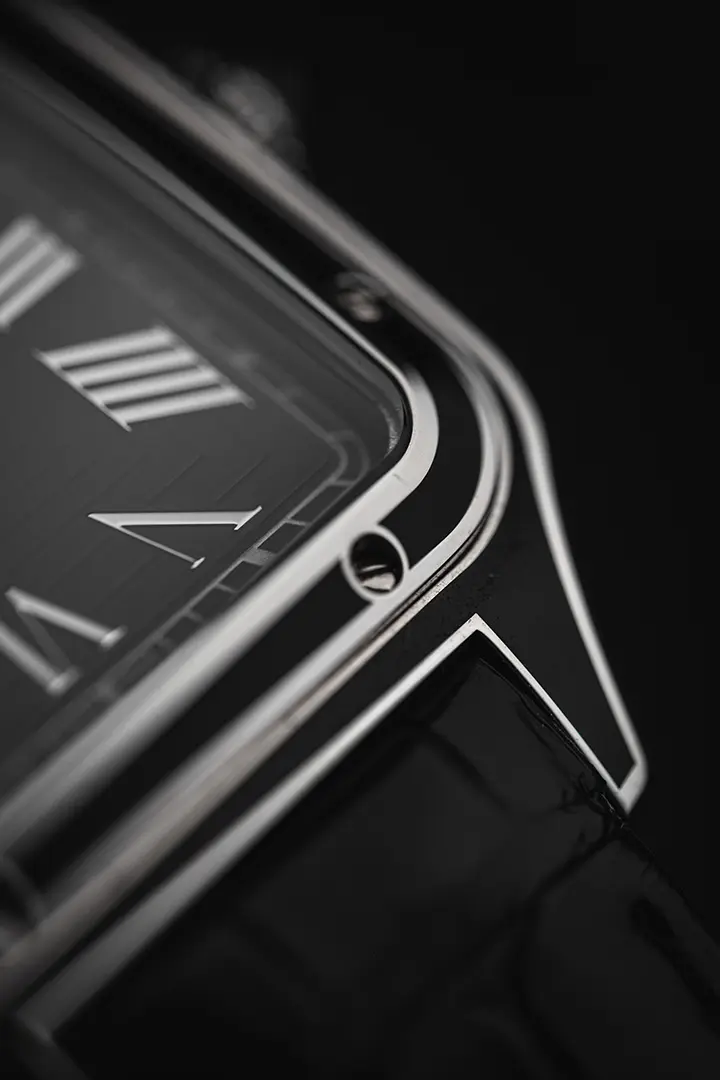
Cartier extends the use of lacquer beyond the dial into the broader structure of the watch. Lacquered inlays are integrated into the watch’s bezel and case. On the steel reference, the chamfers and curves are especially accentuated with the black lacquer finish juxtaposed for contrast.
“On the other hand, the beige lacquer complements, adding sophistication and warmth to the case.” Verne
The rose gold carries an underlying pink hue and, at 18k, is very resistant to tarnishing.
.
Under the Loupe – Continued
Frottage measurement places the crystal and dial aperture at 22.2mm and 23.24mm.
Unlike the quartz movement in the mainline Santos-Dumont, the lacquer models feature the manual-winding Cartier 430MC, a modified Piaget 430P movement. This is a nice touch, as having the mechanical manual-winding movement is more historically accurate and maintains the watch’s original thin profile.
The straps are crafted from alligator leather or high-quality calfskin, featuring a slim profile and precise fit. The selection emphasizes finer cuts with premium patterns and uniform textures.
“The straps sit perfectly flush and are easily changed using Cartier’s trademark QuickSwitch.” Verne
Being a Cartier, the Santos-Dumont carries the signature Cartier hallmarks: blue spinel cabochon (a touch of brilliance) atop a beaded crown, square bezel with exposed rivets (a nod to aviation and industrial heritage), and Cartier buckle (creating soft curves with a mirror finish).
Also honouring its heritage, the engraved caseback displays ‘Cartier’, signature-styled ‘Santos-Dumont’ (inked in the same lacquer) and ‘mécanique’. The rose gold also has a uniquely engraved edition number.
“From its Art Deco influences to its lacquer integration, the watch is a testament to Cartier’s mastery of blending tradition with innovation. Its enduring design, characterized by its square case and exposed screws, has influenced generations and remains unique.” Verne
Across both references, material choices shape how the watches read. Steel uses contrast to sharpen edges, while gold maintains tonal continuity between case and dial. Even within the same reference, steel and gold create distinct wearing experiences.
.
One Year Later
Wearing the Santos-Dumont has deepened my appreciation for Cartier’s designs.
“One of the reasons why I own multiple Cartier watches, is that each iteration is so excitingly distinct, but somehow maintains the essence of timelessness. I have found that I can wear my Santos-Dumonts on any occasion. In a very different way, these watches are strap monsters, you can go dressy to even casual rubber and somehow it all works.” Verne
I’ve come to appreciate why Verne and other Collectors might own multiple Cartier Santos-Dumonts. It made such an impression that I’ve just added a Tank Must de Cartier WSTA0108 to my collection.

If we had one minor criticism, the lacquered dials are spectacular, and anti-reflective treatment on the underside of the sapphire would have enhanced its depth under broader lighting conditions.
Though delicate in appearance, both watches look just as good today as when they were purchased. The brushed finishes conceal minor nicks, and the lacquer remains pristine. The bezels – often criticized in the standard model as scratch magnets – still look great. I don’t handle my watches roughly, but Verne wears his rose gold Santo-Dumont everywhere.
I originally bought the Santos-Dumont for a modern office and evening setting, but it proved just as natural in everyday wear within smart casual. The lacquer continues to hold its presence, while the steel remains understated. In gold, it draws the eye more directly. Each tends to invite a second look, particularly from those already familiar with watches.
.
Where to Buy
Unveiled at Watches & Wonders 2022 in three variations: platinum (150 pieces), rose gold (250 pieces) and steel (slated for regular production). Priced initially at $4,400 USD (steel) and $10,300 USD (gold), these references did not reach boutiques until 2023.
As of this article (May 2025), finding one in-store, even in steel, is rare, but not impossible. Checking in at the boutique, only one rose gold was left in Canada.
I acquired mine trading up, and Verne had the foresight to buy his rose gold in-store at launch. Though “regular production” speculation suggests the steel may be capped at 800 pieces. In hindsight, I wish I had secured mine through cartier.com or an AD reservation instead of hesitating due to wanting to see it in person.
For those still on the hunt, some regions still show the steel at Cartier’s Online Store, and perhaps calling in for a transfer might be possible.
Regarding straps, with the Cartier QuickSwitch consider looking at Delugs, who provide compatible Integrated Straps, Cartier-style buckles, and a wider variety of options and price points.
.
Works Cited
Brickell, Francesca Cartier. The Cartiers: The Untold Story of the Family Behind the Jewelry Empire. Ballantine Books, 2019.
Hoffman, Paul. Wings of Madness: Alberto Santos-Dumont and the Invention of Flight. New York : Hyperion, 2003.
Wings of Madness
Wings of Madness. NOVA directed by Jean-Marc Selva and Brian Dowley, Docere Digital Studios, Inc. and Palace Production Center, 2006.
.
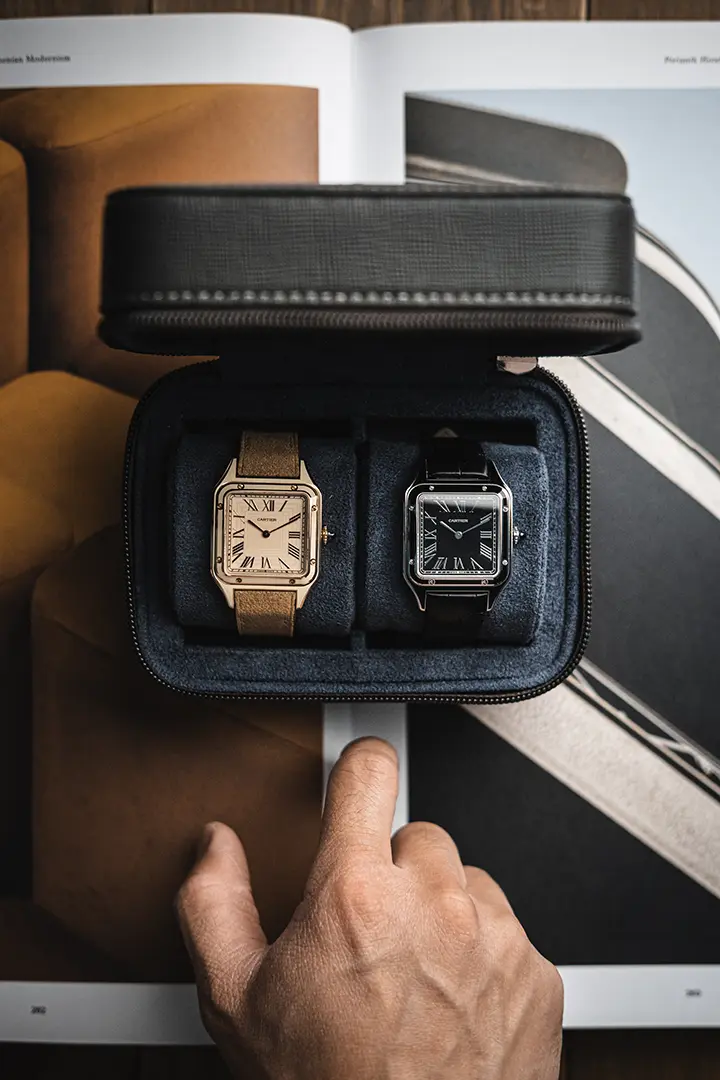
Hi there, what is the model of the one in the picture (2nd from left).
Best wishes,
Ryan
The 2nd from left in the Delugs Watchbox is the W2SA0027 Cartier Santos Dumont Limited (300 pieces) Edition. Exclusive to the Chinese market, it has a champagne dial, jade cabochon and 6 O’Clock marker in traditional Chinese calligraphic numeral.
Here are the references for all the watches in order from left to right: CRWGSA0054 (Rose Gold) , W2SA0027 (Chinese calligraphic numeral), WGSA0102 (Rewind), WSSA0046 (Black Lacquer)